Inca Trail Packing List: What to Bring (and What Porters Carry)
A practical Inca Trail packing list from our Cusco guides: porter allowances, layering for Dead Woman's Pass, rain gear and the small items people forget.
The night before every departure, our guides do the same thing in a hotel lobby somewhere near the Plaza de Armas: they kneel next to a pile of duffel bags with a hanging scale and weigh each one. Some guests are right on target. Others discover they have packed three hoodies and a hair dryer. This Inca Trail packing list is meant to keep you in the first group, with exactly what you need for four days, three nights and roughly 26 miles (42 km) of stone steps, cloud forest and one very cold pass.
It is written for travelers flying in from the US, so we have kept pounds next to kilos and °F next to °C.
What do porters carry on the Inca Trail?
Porters are the backbone of every Inca Trail trek. They carry the tents, kitchen, food, gas and dining gear, and they usually reach camp before you do, often with tea already on. Peru limits how much they can carry: Sunafil, the national labor inspection agency, set the limit at up to 20 kg (44 lb) for men and 15 kg (33 lb) for women, and loads are weighed at the checkpoint.
Because of that limit, operators give each hiker a personal allowance in a duffel bag carried by a porter. Most operators set it at around 6–7 kg (13–15 lb), and that often includes your sleeping bag and air mattress. We confirm the exact figure at your briefing. Anything over the allowance goes in your own daypack.
What goes in the duffel vs. your daypack?
| Porter duffel (about 6–7 kg / 13–15 lb) | Your daypack (keep it under about 15 lb / 7 kg) |
|---|---|
| Sleeping bag and sleeping pad, if counted in your allowance | Water, 2 liters (about 2 quarts) minimum |
| Change of hiking clothes for each day | Rain jacket and poncho |
| Warm sleeping layers, thermal top and bottoms | Warm fleece or light down jacket |
| Camp shoes or sandals | Sunscreen, sunglasses, hat |
| Toiletries and quick-dry towel | Snacks, personal medication, toilet paper |
| Spare socks in a zip bag | Passport (originals only, never in the duffel) |
You will not see your duffel during the day. Porters move fast and take a different rhythm on the trail, so anything you might need before camp goes in the daypack.
Inca Trail packing list: clothing in layers
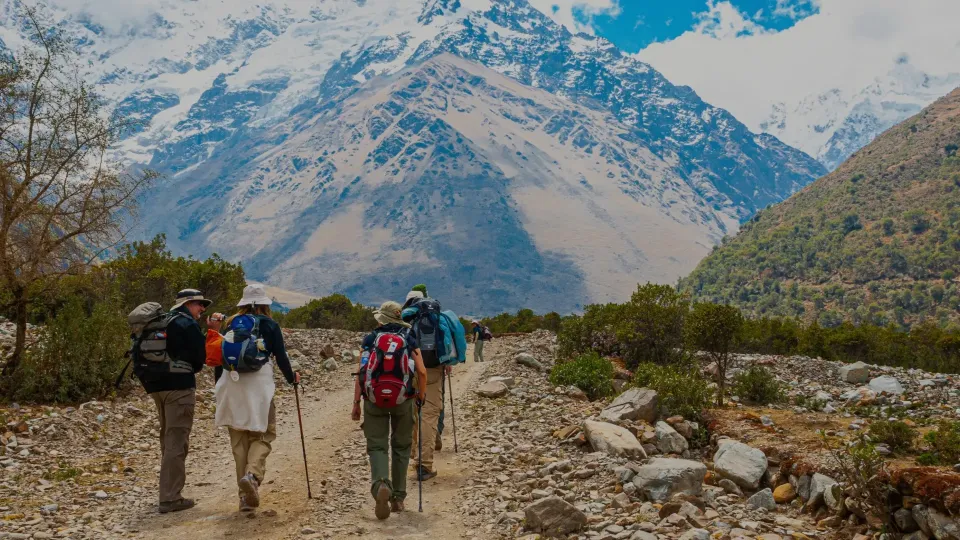
The classic route starts at Km 82, around 8,500 ft (2,600 m), and climbs to Dead Woman's Pass at 13,829 ft (4,215 m). Within a single day you can be sweating in the sun and then pulling on gloves in the wind at the top. Layers work better than one big coat.
- Base layer: two moisture-wicking T-shirts (synthetic or merino, not cotton) and one long-sleeve.
- Mid layer: a fleece, plus a light down or synthetic puffy for camp. Evenings at Pacaymayo and on the high stretches feel cold once the sun drops behind the ridge.
- Outer layer: a waterproof, breathable rain jacket. In the wet months, add rain pants.
- Legs: hiking pants or leggings; convertible pants are handy for the warmer cloud forest on day three.
- Sleep: thermal leggings, a warm top, wool socks and a beanie. Sleeping warm makes the 3:30 a.m. wake-up on the last day much easier.
- Accessories: sun hat, beanie, light gloves, buff or neck gaiter.
Footwear and trekking poles
Bring broken-in hiking boots with ankle support and a good grip. The Inca steps are uneven, sometimes wet and occasionally very tall; the descent from the pass is where knees complain most. Trekking poles help a lot here. We recommend rubber tips on the poles, which are easier on the ancient stone and less slippery.
On any Inca Trail packing list, socks matter more than people expect. Pack two or three pairs of hiking socks and a pair of light sandals or sneakers for camp. One of our guides, who grew up in a village near Ollantaytambo, tells every group the same thing at the first camp: take your boots off right away, let your feet breathe, and put on dry socks before dinner. Small habits like that prevent blisters on day two.
Rain gear: what do you need in the wet season?
The rainy season runs roughly from November to March, and the trail itself closes for maintenance in February. Even in the dry months (May to September), a cloud can drift up the valley and drop rain for twenty minutes. Our minimum rain kit:
- A rain jacket with a hood
- A cheap plastic poncho that also covers your pack (sold everywhere in Cusco for a few soles)
- A pack rain cover or a trash-compactor bag lining the inside of your pack
- Zip bags for your phone, passport and spare socks
If you are traveling between November and April, also check our article on the best time to visit Machu Picchu.
Health, sun and altitude
The sun at altitude is strong, even when it feels cool. The CDC notes that high-altitude environments combine cold, low humidity and increased UV exposure. Pack:
- Sunscreen SPF 50, lip balm with SPF and sunglasses with UV protection
- Insect repellent for the cloud forest sections near Wiñay Wayna
- Your personal medications, plus basic blister care, pain relievers and rehydration salts
- Any altitude medication prescribed by your doctor; talk to them before the trip, not on the trail
- Hand sanitizer and a small roll of toilet paper
Spend at least two nights in Cusco or the Sacred Valley before you start. Our full guide to how to prepare for the Inca Trail covers training and acclimatization in more detail.
Documents, money and small extras
- Original passport. It is checked at the Km 82 control and must match your permit. Read our Inca Trail permits guide for the details.
- Cash in soles, in small bills. There are no ATMs on the trail. You will want cash for snacks and drinks at the first stretch and for tipping the porters and cook at the end. We give guidance on tipping at the briefing.
- Headlamp with spare batteries; the final morning starts in the dark.
- Power bank. There is no electricity at the campsites.
- Reusable water bottles. We boil and refill water at camp.
- Earplugs. Campsites are shared, and roosters do exist in the Andes.
What to leave off your Inca Trail packing list
Most hotels in Cusco store luggage for free. Leave behind jeans, heavy cotton sweatshirts, hair dryers, laptops, most jewelry and anything you would hate to see wet. You will pick up your luggage after returning by train. If you join our Classic Inca Trail 4 Days or the Classic Inca Trail 5 Days, we explain storage and pick-up times during the pre-trek briefing. Heading out on the Short Inca Trail? Then a daypack is all you need. And if you want to picture each campsite before you pack, read the Classic Inca Trail day by day.
FAQ
How much weight can a porter carry for me on the Inca Trail?
Peru's labor authority limits porter loads to 20 kg (44 lb) for men and 15 kg (33 lb) for women. Your personal allowance in the porter's duffel is usually around 6–7 kg (13–15 lb), set by the operator.
Do I need hiking boots or are trail runners fine?
Boots with ankle support are safer on the wet, uneven stone steps, especially on the long descents. Trail runners work for some experienced hikers in the dry season.
Can I rent a sleeping bag and trekking poles in Cusco?
Yes. Most operators, including us, rent them. Ask when you book so the gear is ready at your briefing.
Is a poncho enough rain protection?
In the dry season it often is. Between November and April, bring a proper rain jacket as well.
Not sure about a piece of gear? Send us a photo or a question via https://machulasjourney.com/contact-us/ or on WhatsApp, and one of our guides will tell you if it is worth the space.
Sources
Local guides and travel planners based in Cusco. We walk these routes every season.
About UsTours for this trip
Inca Trail to Machu Picchu
Classic Inca Trail 4 Days Group Tour
Classic Inca Trail 4 days group tour is the perfect choice for travelers who want to experience the most…
- Moderate
- 4,215 m
- Group or private
From US$950per person
Book a trip
Inca Trail to Machu Picchu
Short Inca Trail to Machu Picchu 2 Days
Short Inca Trail to Machu Picchu 2 days is the perfect adventure for travelers who want to experience…
- Moderate
- 2,730 m
- Group or private
From US$560per person
Book a tripInca Trail to Machu Picchu
Classic Inca Trail to Machu Picchu 5 Days / 4 Nights
The Inca Trail is the undisputed attraction for most people coming to Cusco and it is by far the most…
- Moderate
- 4,215 m
- Group or private
From US$1,050per person
Book a trip Trekking Guides